How to tell if a Pokémon card is worth money
Five checks, from the collector number and rarity symbol to the 1st Edition stamp, condition and sold prices, with two worked examples priced on November 6, 2026.
Most Pokémon cards are worth little on their own and a few are worth a great deal. In the 151 set, a common Charmander showed an ungraded price of $1.10 on November 6, 2026; the set's special illustration rare Charizard ex showed $299.95. The gap comes from four things you can check at home: the exact card, its rarity, its edition or print, and its condition. A fifth step turns them into a figure: what that exact card in that condition has actually sold for. This page sets out the method; it is not a price list or an appraisal.
How to tell if a Pokémon card is worth money: five checks
- Identify the exact card: name, set and the collector number in a bottom corner, such as 199/165.
- Read the rarity symbol beside the number (table below). A number above the set size marks a secret rare.
- Check edition, print and finish: the 1st Edition stamp on early cards, the drop shadow on Base Set, holo or reverse holo.
- Judge the condition: corners, edges, surface and centering.
- Look up dated sold prices for that card, print and condition. Asking prices do not count.
- Art box: a holo shines only here; a reverse holo shines everywhere but here.
- 1st Edition stamp on early Wizards of the Coast cards: left side, about halfway down.
- Drop shadow right of the art box: on Unlimited Base Set prints, not on Shadowless.
- Collector number: above the set size (199/165) means a secret rare.
- Rarity symbol beside the number; key on the right.
What the rarity symbol tells you
CGC's guide to Pokémon rarity symbols puts the symbol in the bottom right or left corner, next to the set number. Three symbols are used across eras; Scarlet & Violet added star combinations to separate official rarities from fan names:
| Symbol | Rarity |
|---|---|
| Black circle | Common |
| Black diamond | Uncommon |
| Black star | Rare |
| Black star with “PROMO” | Promo card |
| Two black stars | Double rare |
| Two silver stars | Ultra rare |
| One gold star | Illustration rare |
| Two gold stars | Special illustration rare |
| Three gold stars | Hyper rare |
| Two pastel stars, pink and green | Mega Attack rare (from Ascended Heroes, January 2026) |
Secret rares carry a number above the set size; CGC's example is a Snorlax numbered 224/198. The symbol places a card within its own set, not among all cards, so it is a reason to look a card up rather than a value. Finish matters too: a holo shines only in the art box, a reverse holo everywhere except the art box, and CGC notes that most cards in a set have a reverse holo version, so those are not as rare or sought after. Modern rarities are covered in more depth on the rarest Pokémon cards page.
Edition and print: the 1st Edition stamp
On Wizards of the Coast cards the first print run carried a 1st Edition stamp: CGC describes a “1” on a solid black circle with “EDITION” arched over it, on the left side of Pokémon cards about halfway down. English cards carried it across ten sets, ending with Neo Destiny; Base Set 2 never had it, and no English card has since.
Base Set has two later prints. The second, called Shadowless, dropped the stamp; the third, Unlimited, added a drop shadow along the right side of the art box. They look alike and price very differently (second example below); the Base Set Charizard card file has the full story for that card.
Condition: raw or graded
A raw card is priced by its visible condition, a graded card by its grade. PSA calls a PSA 10 “a virtually perfect card”: four perfectly sharp corners, full original gloss, and centering within about 55/45 to 60/40 on the front and 75/25 on the back. Edge whitening, a soft corner or a holo scratch moves a card down. See the PSA grading scale and the card condition glossary.
Worked examples: same Pokémon, different value
Prices are PriceCharting figures as of November 6, 2026, built from sold listings on eBay and PriceCharting's own marketplace, without shipping. “Ungraded” means no grading company has graded the card; Grade 9 pools PSA and BGS 9s; PSA 10 is PSA only.
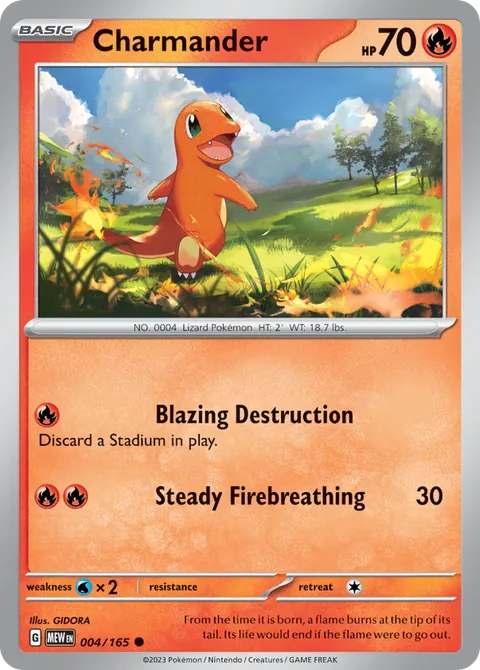 Charmander
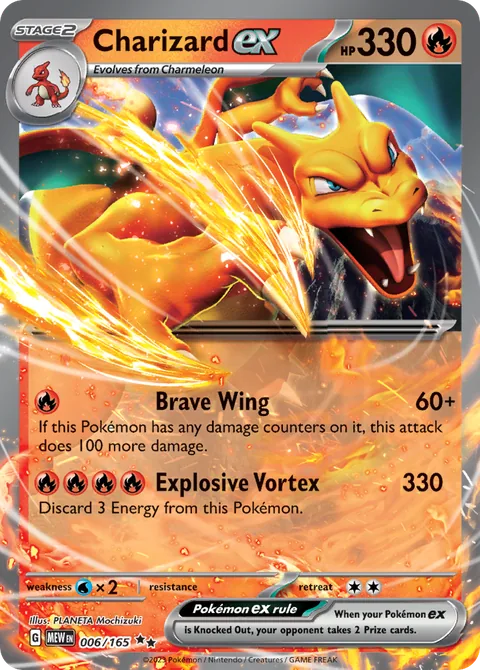 Charizard ex
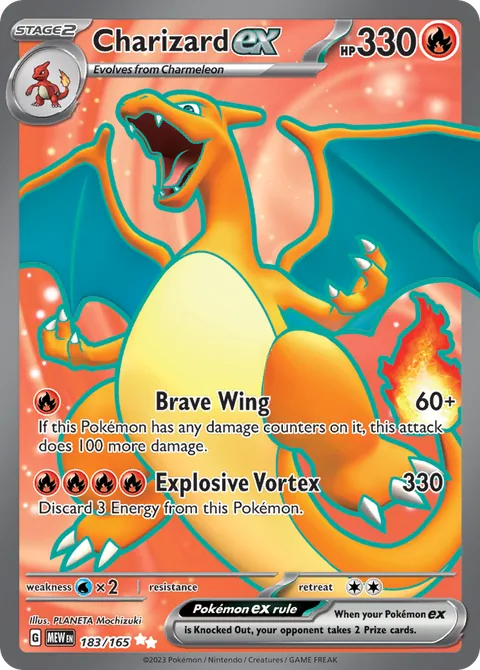 Charizard ex
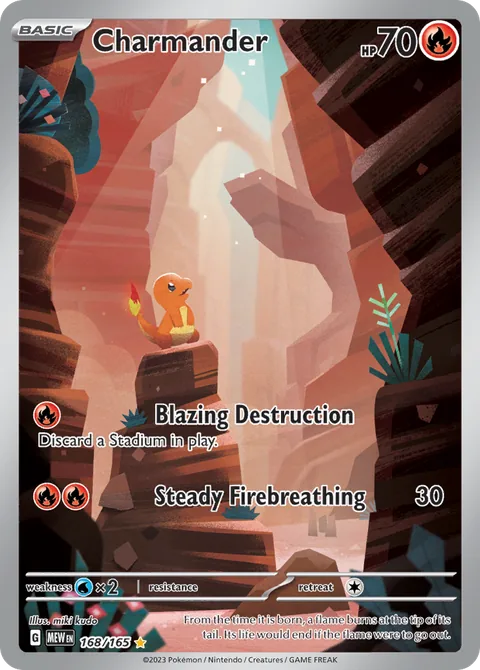 Charmander
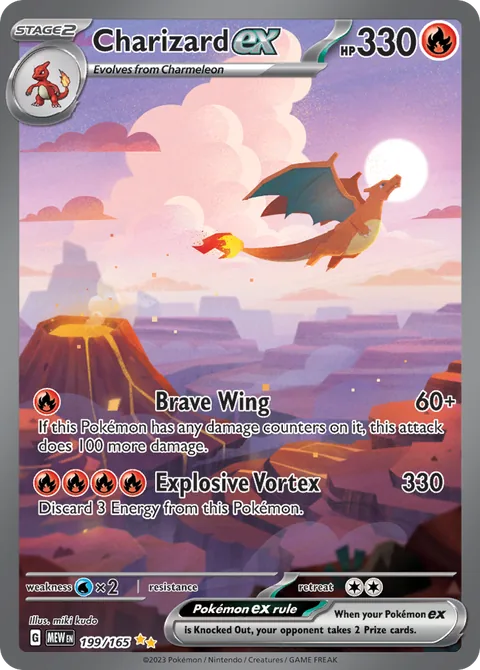 Charizard ex
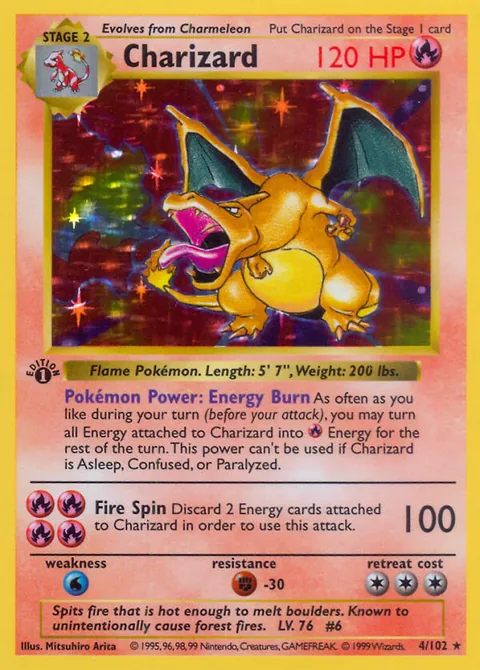 Charizard
Example 1: rarity within one set
| Card | Rarity | Ungraded | PSA 10 |
|---|---|---|---|
| Charmander 4/165 | Common | $1.10 | — |
| Charizard ex 6/165 | Double rare | $7.45 | $120.06 |
| Charizard ex 183/165 | Ultra rare | $36.91 | $195.00 |
| Charmander 168/165 | Illustration rare | $81.94 | $540.85 |
| Charizard ex 199/165 | Special illustration rare | $299.95 | $1,225.50 |
The common Charmander's PSA 10 cell is blank: many graded sales on its PriceCharting page are titled as the Charmander from the Charizard ex Super Premium Collection, a different printing, which is why the exact version has to match. The illustration rare Charmander also out-priced two of the three Charizard ex cards raw: the rarity tier, not the Pokémon, set the order. More of the set is in the 151 set guide.
Example 2: edition and print, Base Set Charizard 4/102
| How to spot it | Ungraded | Grade 9 | |
|---|---|---|---|
| 1st Edition | Stamp, left side | $6,986.22 | $29,278.00 |
| Shadowless | No stamp, no shadow | $1,052.70 | $11,695.23 |
| Unlimited | Shadow right of art box | $376.89 | $2,949.25 |
The same card, artwork and number shows an ungraded 1st Edition price about 18.5 times the Unlimited one.
How to find what your card sold for
Use sold results, not listings. eBay's pricing help separates what other sellers are charging from completed listings, which show “how much items like yours have sold for in the past” (Advanced Search, then Completed listings). PriceCharting summarises such sales and says it filters out reproductions and lots and reviews abnormal prices by hand. Match card, print and condition, note dates, and use a range rather than the top sale. The full method is in where to check sold prices.
Checklist: is this Pokémon card worth money?
- ☐ Name, set and collector number written down.
- ☐ Rarity symbol read; number checked against the set size.
- ☐ Holo, reverse holo or non-holo noted; on a Wizards-era card, 1st Edition stamp (and on Base Set, drop shadow) checked.
- ☐ Corners, edges, surface and centering looked at under good light.
- ☐ Several dated sold prices found for the same card, print and condition.
- ☐ Raw and graded prices kept apart.
Questions collectors ask
Are Pokémon cards worth anything?
Some are worth a lot; most are worth little. In the 151 example a common showed an ungraded price of $1.10 and the special illustration rare Charizard ex $299.95.
How do I tell if a Pokémon card is rare?
Read the symbol beside the collector number: circle common, diamond uncommon, star rare, plus the double, silver and gold stars in Scarlet & Violet sets. A number above the set size marks a secret rare.
Which Pokémon cards are worth money?
There is no single list, because value depends on the exact card, print and condition. Ranked public sales are on the most expensive Pokémon cards page, and set-by-set values are in the set guides.
How much is my Pokémon card worth?
Roughly what the same card in the same condition has recently sold for: find several dated sales and use the range. Whether grading would pay is worked out in is it worth grading Pokémon cards; selling routes are in how to sell Pokémon cards.
Sources
- CGC — “Understanding Pokémon Rarity Symbols and Card Features” (Jan. 10, 2024; updated Mar. 26, 2026)
- CGC — “How to Tell if a Pokémon Card is a First Edition” (June 3, 2022)
- PSA — Grading Standards
- PriceCharting — card pages for Charmander #4 and #168 and Charizard ex #6, #183 and #199 (Scarlet & Violet 151), Base Set Charizard #4 (1st Edition, Shadowless, Unlimited), and its Methodology page (read Nov. 6, 2026)
- Pokémon TCG API — single-card records sv3pt5-4, sv3pt5-6, sv3pt5-168, sv3pt5-183, sv3pt5-199 and base1-4, and the Base set record (names, numbers, rarities, images; read Nov. 6, 2026)
- eBay — How to price your items (completed listings; sports-card price guidance; read Oct. 22, 2026)
Sources checked October 2026.